‘Once, There Were Black Rhinos’ is a large, 34” x 44” original oil painting mounted on archival foam board. A portion of the sale of this artwork will go toward rhino conservation.
The plight of the Rhino is one of the most aggressive examples of humanity’s propensity for destruction through consumption.
As with many wild species, Rhinos once roamed their native habitat in the millions, only to have their numbers decimated by human contact. Through colonial era wholesale hunting, loss of habitat, and more recently the onslaught of illegal poaching, Rhinos have been nearly eradicated in the wild.
In 1977 the Black Rhino population was counted at around 70,000. By 1995 that number plummeted by 96% to a little over 2400 individuals due to poaching.
Through conservation efforts by NGO’s like Save The Rhino and the International Rhino Fund, the Black Rhino population has recovered to over 6,000 individuals today, but the Black Rhino along with three other subspecies remain critically endangered and under threat.
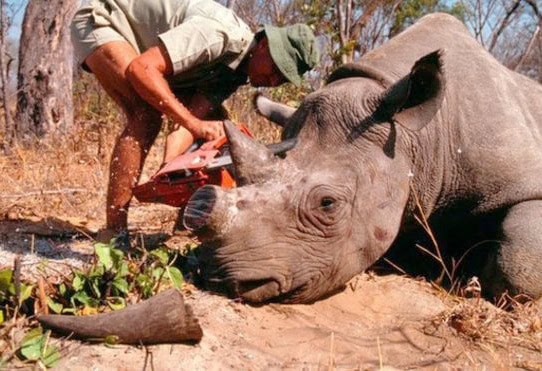
Poaching remains the most critical threat to rhinos. Rhino horn is erroneously believed to have medicinal and sexual stimulant properties.
For this reason, it’s sought out and primarily consumed by the Asian market, with China often cited as a main contributor to Rhino poaching.
Efforts to educate younger consumers about the plight of endangered species in China, along with government bans on horn and ivory, appear to have suppressed the Chinese market to an extent. Unfortunately, demand continues to thrive in surrounding countries.
While individuals and organized criminal networks continue to poach and African governments debate whether or not to legalize the trade in Rhino horn as a means to fund conservation, this prehistoric species teeters on the brink as a unfortunate example of humanity’s failure to manage its own hubris.
Once, There Were Black Rhinos
“Once, There Were Black Rhinos” is the first work in a planned series highlighting endangered species.
As with most of my work, I begin with a sketch that allows me to tack down composition and subject position). With this painting, the composition will be simple with most of the impact coming from the texture, color and lighting of the finished artwork.
Art school teachers will often rail against it, but I love the center placement of a subject. It adds instant impact.

A Rhino is essentially a rectangle, so after finishing the sketch I move forward by drawing her onto the canvas using a rectangle as a container.

Once she’s drawn in, I begin my favorite part of the painting process, laying in color and texture.
It was a deliberate decision to have the background texture closely mimic the texture of Rhino skin. I create this effect by applying glazes and then pulling them off, waiting for a layer to dry, then applying another layer. It takes several days to get the depth and effect I desire since oils take a day or so to cure-to-touch.

Here I decided to take a couple days break from this work to allow the under painting to completely dry. The WIP continues below.
Recently, the last male Northern White Rhino in the world passed away, a sad but powerful testament to the reality of human-driven extinction.
The plight of Rhinos has haunted me for years because it is such an audacious and embarrassing display of our species’ proclivity for single-minded behavior and unmitigated greed.
Sadly, the illegal trafficking of wild life and wild life by-products is a multi-billion dollar international trade where rare and endangered species are merely viewed as a commodity:
Fighting against this tide are individuals and organizations who work tirelessly to preserve and protect the animals that remain. From time to time, I donate a portion of sales from artwork to social and environmental causes. Proceeds from this oil painting will be donated to the International Rhino Foundation, a 501(c)(3) dedicated to supporting Rhino conservation.
Finishing Up “Once, There Were Black Rhinos”
After building up the deep earth tones of the background, the last touch for this painting is reverse-texturing it with a lighter-tone coat of paint. I have a method I use called “texture stamping” that involves a sheet of crumpled material coated in paint that I repeatedly press to the substrate to build the desired effect.


Once this layer is dry, I finish up by applying a complimentary blue wash to the background to create a cooler-toned contrast to the Rhino’s warm skin. This helps to lift both her and the egrets off of the canvas. The complete effect can be seen below:

 ‘Once There Were Black Rhinos’ is a 34″ x 44″ painting depicting a Black Rhino in dramatic lighting that either shows the endangered animal fading into darkness, or emerging from the brink of disappearance. The cattle egrets on her back are either a symbol of hope, or the foreboding of this great land mammal’s disappearance from Earth.
20% of the sale price of this painting will be donated to support the efforts of the International Rhino Foundation.
Click here to purchase this artwork.
Supporting the International Rhino Foundation

When I donate to non-profits I turn to Guidestar or Charity Navigator to make certain the organization I’m supporting is above board. Both Guidestar and Charity Navigator rate 501(c)(3) foundations on fiscal responsibility, how well a non-profit adheres to its stated mission, and how well a 501(c)(3) follows good governance practices that prevent unethical activities. The International Rhino Foundation receives top marks from both organizations, (the Gold Seal of Transparency and a 4/4 Star Rating respectively). 90% of donated funds go toward the foundation’s mission—conservation efforts —which is an excellent ratio for a non-profit.
IRF’s Development Officer was kind enough to answer a few questions for me about Rhinos’ status in the wild and the work conducted by the foundation:
How was the International Rhino Foundation started?“More than 25 years ago, Zimbabwe’s black rhino population was decreasing at an alarming rate from intense, organized poaching. In response, a group of concerned individuals and institutions founded the Black Rhino Foundation in 1989 to assist in the conservation of black rhinos in Zimbabwe through efforts in the wild and in captivity. In part because of the Black Rhino Foundation’s support, poaching was virtually eliminated and Zimbabwe’ black rhino population began to stabilize. In most areas throughout the species’ range, numbers are now increasing. In 1993, recognizing that the escalating crisis facing all five rhino species was not receiving the attention it deserved, the Black Rhino Foundation expanded its mission and became the International Rhino Foundation (IRF).”
At this moment, how many Black Rhinos are left in the wild? How many Rhinos over all?“There are between 5,042 and 5,455 Critically Endangered black rhinos left in the wild. There are approximately 29,000 rhinos (all five species) in the world today. An estimated 1,109 black and white rhinos were poached in Africa in 2017.”
How does the IRF fulfill its mission to help these animals?“All five living rhino species (Black, White, Greater One Horned, Sumatran and Javan) are in terrible peril – from poaching, from forest loss and habitat conversion, and from human settlements encroaching on their habitats in Africa, Indonesia, and India. IRF works to protect particularly threatened rhino populations (and their habitats) in the wild, while also supporting management of and research on captive populations that will facilitate better management for wild populations.”
What is one thing a concerned person can do today to save rhinos and other impacted wild life?“There are many things concerned individuals can do to protect rhinos and other endangered species: donate money to organizations that protect wildlife, share information about rhinos and the threats they face, refrain from buying any illegal wildlife trade products, and encourage their governments to enforce laws against illegal wildlife trade.”
—
To support the IRF’s mission and learn more about their work, visit their website: https://rhinos.org/.
And of course, if you are looking for a striking original artwork to grace your wall, a portion of the proceeds from the purchase of “Once, There Were Black Rhinos” will be donated to the IRF.
Click here to purchase this artwork.