

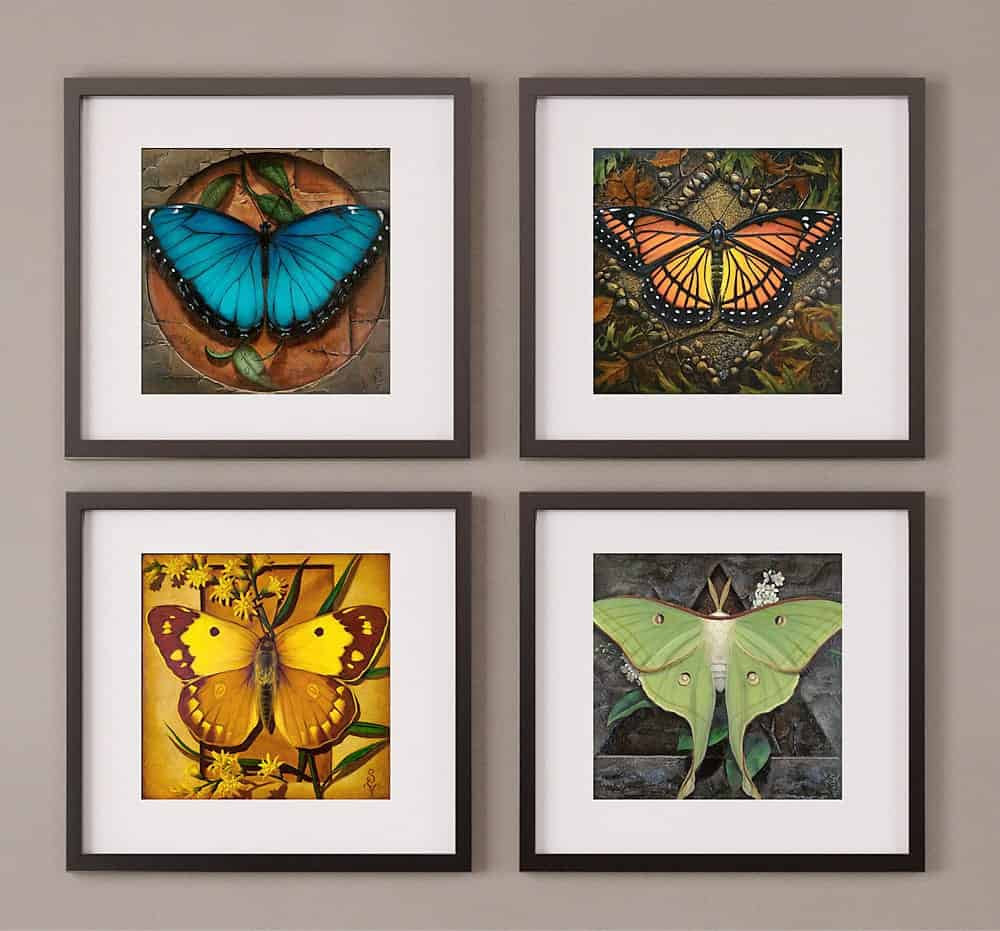
Big, bold artworks are almost like a décor cheat code; they instantly attract attention and quickly fill empty spaces, but small art has a compelling history and definite power of its own.
You’re forgiven if you’ve been guided to believe bigger is always better. Particularly if you’ve lived and worked in a Western culture, whether buying lunch or shopping for a car, we’re constantly receiving messaging that serves up small as a less desired option when going big is on the table.
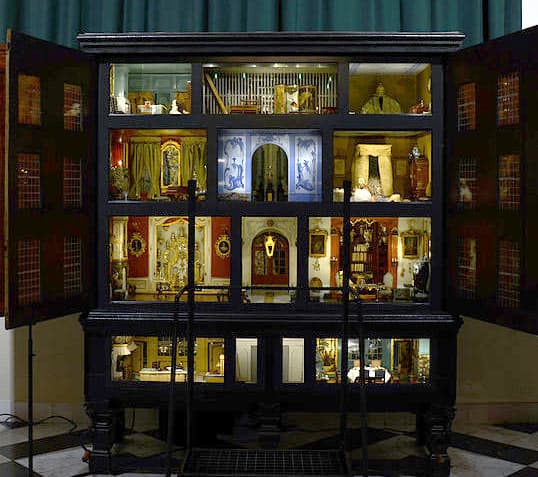
When it comes to art, though, nothing could be further from the truth, and our ancestors were well acquainted with the value of small works. From tiny prehistoric fertility sculptures to locket-sized paintings of loved ones, people have treasured small works of art for thousands of years. In some cultures, tiny has even been regarded as a status symbol; take, for example, Dutch cabinet houses that weren’t mere children’s toys but a method of displaying household wealth.
Small Artwork Commands Intimacy
As an artist, I love creating large-scale artwork. It allows me more oxygen for placement and arrangement of subject matter in a composition, and I can just wander off on an expansive journey when it comes to adding detail. But, there is definitely something to be said for the power of diminutive art.
From a creator’s point of view, small art challenges an artist to be a bit more circumspect in their decision-making, something that I’ve learned with my own foray into working at a smaller scale.
From a viewer’s point of view, small artworks can provide a personal experience unmatched by bigger pieces. They coerce you to come closer so that they can divulge their secrets in more intimate proximity. They have a way of hooking a finger into your collar and pulling you in, requiring your complete focus to enjoy what they have to say.
Also, if you’re seeking variety, you’ll be well rewarded. Small art comes in many styles and forms—sculpture, jewelry, photography, and even micro books. For this article, I’ll be focusing on painted or printed wall art since it’s ubiquitous and easy to find, but rest assured, if there is a particular object you’re seeking in tiny scale, you can likely locate an artist who makes it.
And what qualifies as small? It varies. If your idea of big artwork is human-size, say five feet or more, then something 20 inches or less might seem absolutely tiny. For someone else, only something the size of a sheet of printer paper or smaller would qualify. From personal observation, 14 inches and under is usually what art shows and exhibitors describe as small artwork, so that’s the scale used here.
And before we dive into the benefits of collecting these small-scale treasures:
Why You Can Thank Islam and Genghis Kahn’s Grandson for Small Art
At least in part, small art as we know it today can trace its origins to the practice of hand-painted book illustrations that were created over 2000 years ago. At some point, the making of these detailed colored plates left the pages of books and became free-standing works of art.

Over centuries, they were crafted on a range of substrates, from playing cards and vellum to glass, metal, and ivory. They were used to commemorate the coronation of queens, the passing of loved ones, or as mementos gifted to spouses or lovers. The practice of painting small art jumped continents with the spread of colonization and eventually became established in the Americas too.
In the West, the advent of small-scale painting is often credited to Renaissance-era artisans who toiled away at intricately illuminated manuscripts and choir books. However, the historical roots of this tradition go back much farther. While the oldest known examples of painted manuscripts derive from the Germanic Osthrogoths (sometime between 400-600 CE), it was Arab culture and the Mongol siege of ancient Baghdad that was ultimately responsible for making it a multi-cultural phenomenon.
After the passing of the Prophet Muhammad in 632 CE, four consecutive caliphates came to power, responsible for the rapid expansion of the Arabic empire within a 100-year period. The territory captured stretched across Northern Africa, the Arabian Peninsula, and parts of Asia.
Within this Golden Age of Islam, the Baghdad School of Miniature Art was established under the auspices of the Abbasid Caliphate. Though short-lived, the intricate illuminated paintings and calligraphy work of the school’s artists had a lasting impact on Mesopotamian culture. Artists were charged with capturing images of everyday life (think of candid photography today) and illustrating stories of conquests by great rulers and military leaders.

The school and Baghdad itself were laid to waste in a 1258 siege led by Hulagu Khan, grandson of Genghis Kahn. Subsequently, the Arabic artists of the school were scattered to neighboring territories while also being absorbed into the Mongol empire. While the core of the distinct Arabic painting process wasn’t completely obliterated, it was morphed by the adoption of Chinese and Persian influences (carried by the Mongols) while also cross-pollinating the artistic style of the region’s invaders.
The last and ultimate assimilation of the Arabic miniature painting tradition occurred under the 14th-century Ottoman Empire. Due to the cross-cultural exchanges that were part and parcel of the Silk Road (a centuries-old network of trade routes connecting the East to the West), Italian and Catholic artisans were exposed to and strongly influenced by the illuminated manuscript works making their way to Europe. Some even went to study in ateliers sponsored by Turkish sultans.
While small painted artworks would go on to change in form from bookplates to more portable and wearable artifacts with vastly different significance, nearly all forms of miniature painting in part owe their existence to the Arabic miniature tradition and the caliphate patrons who supported it.
5 Benefits of Collecting Small Artwork
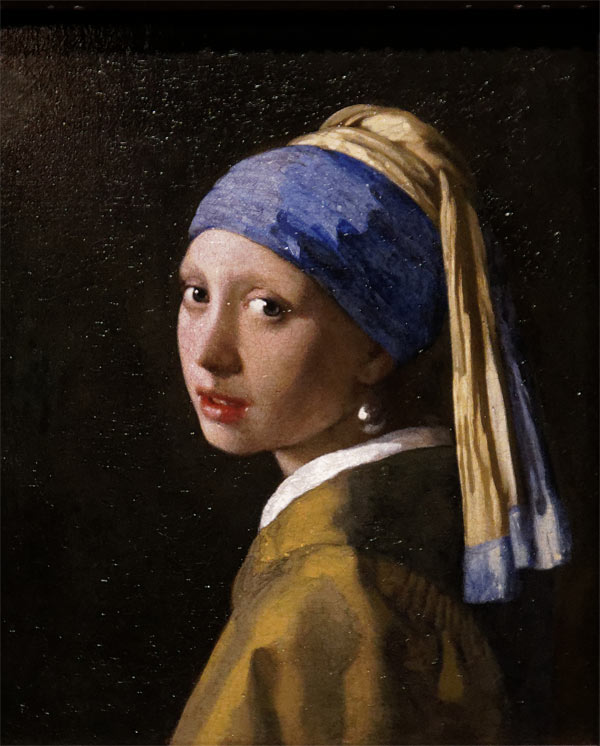
Besides the air of preciousness that surrounds a small artwork evoking an attention-grabbing power, miniature art also has many practical advantages. Their reduced proportions allow for easy handling, they can work nicely as interior accent pieces pulling together the overall design of a space, and you’re less like to break your back moving them between rooms.
Below are 5 more great reasons to consider adding small artworks to your collection.
1. Small art allows you to get familiar with an artist’s work
A small artwork can be viewed as a sampling of a creator’s catalog before making a deeper commitment to collecting a new artist’s work. These miniature pieces are usually purchasable at a lower price point, making them highly attainable and less likely to trigger buyer’s remorse if, at a later date, you decide you no longer want the piece. This last point leads to another benefit of collecting small art if you find you need to re-home it:
2. Small art makes a great gift
Their small and precious stature, combined with the fact that they’re handmade, makes small artworks thoughtful and meaningful gifts. In a world where most everything is mass-produced, it’s truly special to receive something that no one else in the world owns. While almost everyone enjoys art, some may be intimidated by the idea of purchasing art for themselves. A small artwork given as a gift makes a memorable impact and may also lower barriers to future art collecting for the person receiving it.
3. Small works of art fit almost anywhere
If space is at a premium, it doesn’t bar you from indulging in the joy of decorating your home or workspace with original art. There’s a great art documentary about storied collectors Herb and Dorothy Vogel, a New York couple living in a tiny apartment with walls covered with thousands of cherished works. While not all collectors will (or even want) to amass a collection as impressive as the Vogels, the point is that small works allow you to place them almost anywhere, even if available space is limited. Think bookcases, nooks, photo ledges, recessed walls, dresser tops, nightstands, etc.
4. Small art is affordable
Art buyers sometimes assume that a limited budget means reproductions or framed posters are the only real options available to them; however, many artists produce original small-scale artwork at comfortable prices. As a collector, you may find that buying smaller works allows you to eventually create a more impressive collection than if you’d purchased fewer, larger pieces. And another great bonus, especially if you are an international art buyer, is that the shipping cost will usually be less than if you purchased a larger artwork.
5. You can group small artwork together for impact
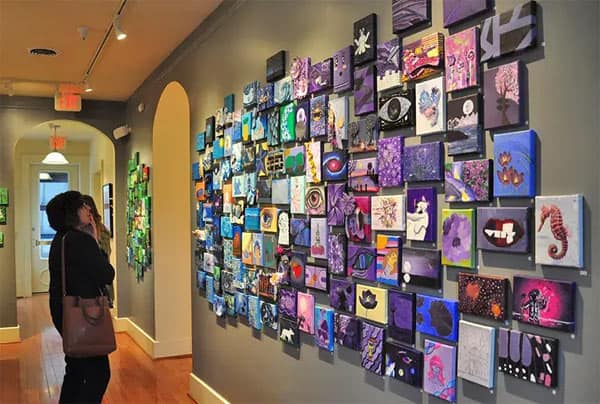
Large works of art quickly fill a space; however, if you like collecting multiple pieces, small art allows more options, like grouping wall hangings in a salon-style display. Multiple works hung in a group make quite an impact and give you greater creative control over the final presentation. Just by choosing how you arrange a group of small pieces together, you can effectively create a new artwork.
How to Find and Buy Small Works of Art
Art collectors typically find artists through online web searches, picture-heavy social media platforms like Instagram, or via traditional hunting grounds like galleries and art fairs. If you see a particular artist you like, ask if they have small-scale works, you might be surprised by how many actually do.
Another method is to visit themed shows and exhibits. There has been a modern resurgence in the small art tradition, and to meet demand, some galleries have annual shows dedicated just to miniature works. Examples include Abend Gallery’s Annual Holiday and Miniature Show, the Mamaroneck Artists Guild’s Small Works Show, and Main Street Arts Small Works exhibition.
And, of course, I’ve made my own venture into creating small works too. It’s become a regular part of my meditative practice, and the ones I deem worthy of making their way to collectors end up listed here or through my mailing list for art collectors, Addicted to Detail.


